Updated: May 10
A combination of rites and usages from Syria, Jerusalem and Constantinople. (We are not foreigners.) by Rt. Rev. Philip Raczka, PhD
- Syria – basic prayers for the Divine Liturgy, Sacraments and Divine Office
- Jerusalem – Structure of the Divine Office, Hymns, Liturgical Year
- Constantinople – Hymns, architecture, imperial ceremonies, refinement, lectionary, processions including the 3 antiphons, the Trisagion and the Ecumenic Litany
- Evolution of the Divine Office through the centuries
Part 1: Heritage from Syrian Antioch
The Constitutions of the Apostles gives us the Liturgy near Antioch ca. 380 AD. In it we see diaconal litanies followed by presbyteral prayers, and the Antiochian style Anaphora. We also see a pattern for the Divine Liturgy consisting of a prepatory prayer before the Anaphora, Anaphora, prepatory prayer before Communion, Invitation to Communion: Holy Things for the Holy, a prayer after Communion and a dismissal prayer.
Regarding the Antiochian Anaphora: The ancient anaphora of the 2-3rd centuries consisted of a thanksgiving for salvation and an intercession for the Church. In 4th Century Antioch this was further developed by inserting sections reflecting the theology of the Liturgy that was already in existence.
Antiochian Anaphora
| Parts of the Anaphora | Comments |
|---|---|
| Thanksgiving for all blessings, especially salvation through Christ | Found in the Didaché |
| Sanctus | We worship with the angels |
| Institution Narrative | Why we are doing the Eucharist, at the command and example of Christ |
| Offering and Anamnesis | We are offering our sacrifice to God in memory of our salvation |
| Epiclesis | Petition for the Holy Spirit to transform the Gifts |
| Expanded Intercessions for the Deceased Expanded Intercessions for the Living |
With the Divine Victim on the altar, the Father will not refuse our requests (Theodore of Mopsuestia) -The Deceased form one Church with us. -We should pray for the whole world |
Regarding Christian Initiation we see a pattern as follows: Exorcisms, Renunciation of Satan and attachment to Christ, blessing of the water, blessing of olive oil, anointing, immersion, private prayers of intercession by the newly baptized, vesting and going to the church for the Divine Liturgy. Note: there was no anointing with Chrism. In the 4th Century Chrism was used in Rome, Alexandria and Jerusalem. In Christian Initiation the emphasis was upon divine adoption. The 4th Century Fathers preached on Romans 6, dying and rising with Christ, but it was not reflected in the ceremony until later.
Regarding the Divine Office, which will be discussed in detail below, we see the singing of Psalm(s)/hymns and then the service of intercessions. There was a litany and prayer for the catechumens, a litany and prayer for the penitents, and then a litany of the faithful followed by a prayer and dismissal. This service of intercessions was followed for Vespers, Orthros and the Divine Liturgy.
Part 2: The Contribution of Jerusalem
The 4th Century Divine Office in Jerusalem consisted of: Hymns and prayers done as a vigil in the courtyard of the church, 3 Psalms/Hymns and 3 prayers inside the church, a prayer of intercession by the bishop wherein he mentions many people, a dismissal prayer and the kissing of the bishop’s hand. Later on, in Constantinople, this service was prefixed to the Antiochian Divine Office, but omitting the bishop’s intercession and the kissing of the bishop’s hand. Later on, the kissing of the bishop’s hand was replaced by the kissing of the cross.
Many hymns were written in Jerusalem over the centuries. Some of the famous hymn writers were the three foster brothers (8th Century): Saint John of Damascus, Saint Cosmas the Poet and Saint Andrew of Crete. The Octoechos was invented in Jerusalem, and spread from there. Since the 4th Century the hymns of Jerusalem were noted for being suited to the place of the service, and the event being celebrated.
The Liturgical Year developed in Jerusalem with celebrations for the various events in the life of Christ held at the places where they happened. Therefore, such feasts as Palm Sunday, the Holy Cross, and the Ascension were added to the calendar. Feasts of the Virgin related to places where she lived also started in Jerusalem: her birth, presentation in the temple and her dormition. These feasts gradually spread to other cities. Jerusalem also had octaves for feasts. In the 4th Century there were octaves for the Dedication (September 13), Epiphany (January 6) and Pascha. Eventually almost every feast had an octave. In Constantinople for the First Millenium only Easter had an octave. The idea of having octaves for most great feasts was imported from Jerusalem to Constantinople.
Part 3: The Heritage of Constantinople
Money was not a problem in Constantinople. The wealth of the traders and the imperial resources meant that great things could be done and paid for. Hymns: Saint Romanos the Melodist (6th Century) came from Syria. He was supported in Constantinople in order to write and sing hymns, especially the Kontakia. Agia Sophia had more than 40 full time cantors to insure the singing of all of the services. Other hymn writers would also work in the capital.
Byzantine Hymn Writers1
| From the Middle East (Greater Syria & Palestine) | From the Byzantine Empire (including Sicily) |
|---|---|
| Saint Romanos the Melodist (+549?) | Saint Theodore the Studite (+826) |
| Saint Sophronios of Jerusalem (+638) | Saint Joseph the Studite (+832) |
| Saint John of Damascus (+749) | Saint Joseph the Hymnographer (+886) |
| Saint Cosmas the Poet (+787) | Emperor Leo IV of Byzantium (+912) |
| Saint Andrew of Crete (+740) | Saint Kassiani (+890?) |
| Sergios of the Holy City | Simeon Logothete (10th Century) |
| Andrew the Blind of St. Saba (8th Century) | John Marvropous of Euchaita (11th Century) |
| Stephen the Sabaite (+807) | Patriarch Philotheos of Constantinople (14th Century) |
| Saint Theophanes Graptos (+845) |
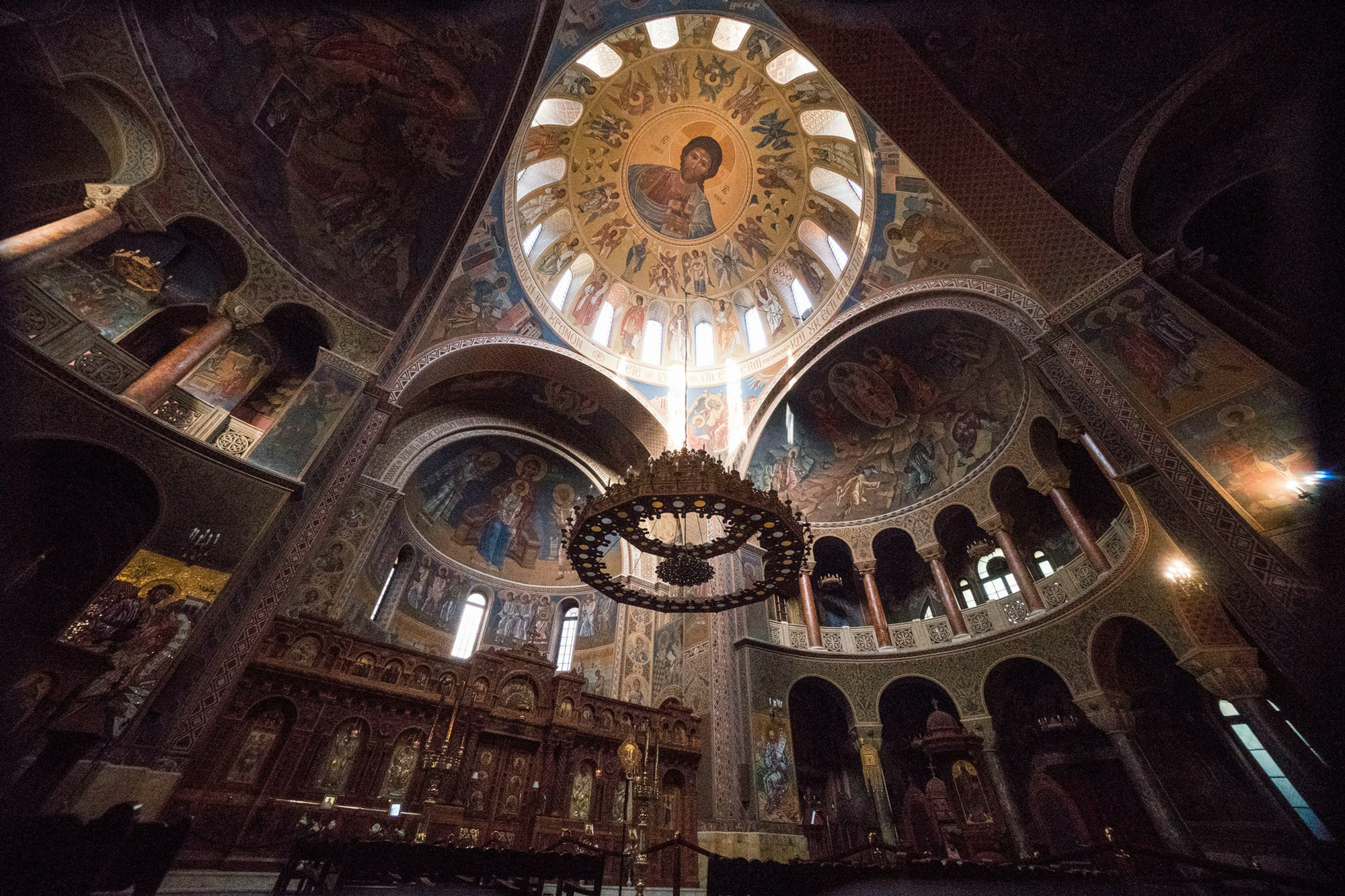
Church Architecture: With rich patrons of all classes church architecture was grandiose in Constantinople. Agia Sophia with its massive dome (107 feet in diameter) would dominate the imagination of generations. There were also 8 sided churches like Saints Sergius and Bacchus. Important for later history was the cross shaped church. This was a domed church with the dome supported on 4 barrel vaults. If a larger church was desired, then more barrel vaults and domes were added. The best know example of this is Saint Mark’s Basilica in Venice, Italy, which was modelled on the Church of the 12 Apostles in Byzantium. All over the Byzantine world these churches were copied even on a small scale. This is how the idea was born that a byzantine church should have a dome.
Imperial Ceremonies: The imperial court took part in the worship of the capital, but at first it did not influence the ceremonies that much. The influence of the court was felt more from the 14th century on. This is when the Dikerion and Trikerion entered the service of the bishop. Originally, they were used by the Emperor. After the fall of the Byzantine Empire, the patriarch started using the Imperial Sakkos as a vestment instead of the phelonion, and he started using he imperial crown as well. These were gradually extended to other bishops over the centuries.
Refinement: The sophistication of the imperial court affected everything including the Church. Customs and usages could have been imported from other places, but in the capital city they received a refinement and polish. This is evident in art and other fields as well including prayer texts.
Lectionary: The Lectionaries of Rome, Jerusalem, Antioch and Constantinople were all different from each other. This means they were local creations. That of Constantinople is what we still use today. It evolved as follows:
- 4th Century: Readings for Saturdays, Sundays and Feast Days. Weekdays were added in the 8th Century. Weekdays of Lent originally had only readings from Genesis. Before 550 AD readings from Proverbs were added to Genesis, and the reading of Job during Holy Week began.
- Orthros Gospels were added in the 9th Century
- Holy Week Pannychis readings were imported from Jerusalem before the 10th Century
Processions and 3 Antiphons, and the Trisagion, and the Ecumenic Litany: Saint John Chrysostom ordered night time processions through the capital before every Saturday, Sunday and Feast Day Liturgy. These processions were accompanied by the singing of hymns/Psalms. Over the years these processions were reduced in number to 68 by the 10th Century, and performed mostly in the mornings between Orthros and the Divine Liturgy. They still left a mark on the Liturgy. The Service of 3 Antiphons was originally performed as a station stop during the procession. The Trisagion was used as the hymn to enter the church when the procession arrived, and the Ecumenic Litany was the intercession used after the singing the 3 Antiphons at a station stop.
Note: There are sources to back up all of the above information. I just did not have the time to make the footnotes. Hopefully I can do that in the future. – Father Philip Raczka
1 Mother Mary & Kallistos Ware, The Lenten Triodion (London & Boston: Faber & Faber, 1977), 40-42.